
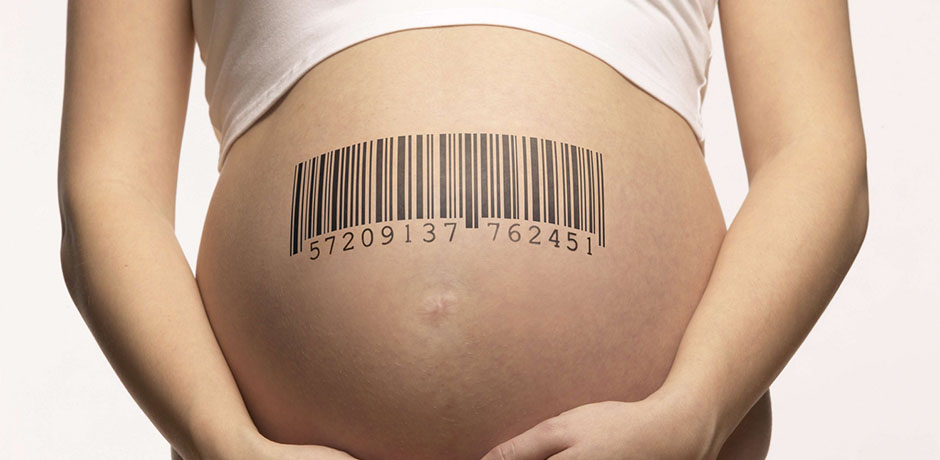
Gestational surrogacy offers couples who cannot or who do not want to physically conceive, the potential for a baby that is biologically theirs, becoming a more popular choice of alternative family-building year on year. Many famous people, such as Kim Kardashian and Paris Hilton, have used surrogate mothers to bear their children, in some cases as they could not have their own and for others because they themselves did not want to.
It remains legal in most countries around the world, with the industry’s value predicted to rise from $14 billion in 2022 to nearly $129 billion in 2032, turning it into a mainstream mode of starting a family.
Though gestational surrogacy (using artificial insemination) is a modern conception, first done in 1985, the act of carrying another’s’ child on their behalf (traditional surrogacy) goes back thousands of years and has been recorded in many cultures.
The Old Testament’s Book of Genesis recorded surrogacy in the story of Sarah and Abraham – wife and husband. After experiencing infertility, Sarah asked her servant, Hagar, to carry their child; Abraham impregnated Hagar, giving the couple the son they wanted.
Similarly, in the same Book, Rachel and Jacob were unable to conceive, thus the couple used maid Bilhah to carry their offspring: to “have children through her”.
This dynamic of a poorer lady carrying the child of a richer lady is not simply a Biblical myth, told by ancients, carried out long ago and far away, but rather, it is a reality experienced by thousands of working, underprivileged women, around the globe every single day.
As can be seen in these examples, who becomes a surrogate mother, the reason why, whether she had agency or not, is all socially bound.
In the midst of surrogacy’s growing popularity there lies a dark underbelly which must be uncovered – I ask who is surrogacy costing and what are the dark truths underlining it?
Quite simply put, on a global scale, commercial surrogacy relies on the poorest, most marginalised women often being exploited by wealthier couples.
Though many argue it is surrogate mothers’ choice to enter these arrangements, the majority of women who become surrogates are in poverty, or come from less developed countries, whilst buyers are from richer countries or the upper classes of the same country.
Women in surrogacy are often marginalised and disadvantaged, at a stark contrast to those who CAN and DO pay, who frequently are much more well off. There is a clear divide between demand and supply – it is an imbalance reflective of the divisions between global North and global South – most buyers are from the West or global North, and most ‘sellers’ are from the global South.
Many other industries emulate this same dynamic: of labour being carried out by women in poorer countries, whilst consumers in wealthier countries benefit from the products and services they get from such cheap production costs and lax labour laws in developing countries.
However, surrogacy is a particularly sinister industry in that it puts at risk the woman’s life, the woman’s future fertility, the woman’s health (both mental and physical), for a price. It renders womens’ reproductive systems and their capabilities a service or a baby-factory, which richer people are able to ‘buy’ and ‘use’.
Leftists often broadly critique capitalism and exploitative labour practices – but why do we stop when it comes to surrogacy and sex work? Why do we leave the exploitation of women’s bodies exempt? Why do we argue that it is the same as any other service, such as shoe polishing or accounting and that it is no different? Why do we argue it is a woman’s own free-willed choice, even whilst understanding poverty is not a choice?
Liberal feminism has incorrectly taught us that a woman can do irreversible damage to her body (in many cases: extreme kinks as normalised through pornography) or subject herself to psychological suffering (in many cases: sex workers disproportionately suffering from mental health problems, such as PTSD), so long as it is “her choice”, it is an okay one. Will liberal feminism take us to the point where a woman can end her life under the “feminist” label for it to be okay? Poverty is not a choice – thus that which is done out of poverty is also not a choice – let alone something that should be hailed by liberals globally.
In true dystopian fashion, worldwidesurrogacy.org offers compensation of $8000 if a woman loses her reproductive organs. And $4000 if partially lost. So why is surrogacy hailed as a liberal, feminist ‘option’ when the industry literally puts a price on a woman’s reproductive system, rendering her body a service? A human incubator?
Certainly, worldwidesurrogacy.org is much more legitimate than commonly underground, informal methods of conducting surrogacy agreements, however the biological risk remains the same to the woman in question.
To showcase the sheer weight of the act of being a surrogate, there are just some of the common complications of pregnancy: high blood pressure, pre-eclampsia, gestational diabetes, misscarriage, infections, ectopic pregnancies, depression, anxiety, psychosis, stillbirth, premature birth, iron-deficiency anaemia. Less common, but more serious complications can include death and future infertility.
Is it fair to put a price on human lives and their curation? To me, it is certainly a problematic premise with dystopian, Handmaid’s Tale-esque potential.
‘Well then surely it is the commercialisation of surrogacy which is the problem, rather than surrogacy in and of itself?’
We are certainly right in pointing out the commercialisation and capitalisation of ANY practice has had exploitative and catastrophic impacts on society and the globe.
Many argue that altruistic surrogacy (done out of charity and goodness, for example between friends) should be allowed, that it is only commercial surrogacy which is a problem, such as Australia’s legislation which rules the latter illegal and the former legal.
However there are many who also argue there is no way of truly demonstrating what counts as altruism and what does not. Under capitalism, and particularly in the face of such extreme income inequality, women who are poorer will INEVITABLY be the ‘suppliers’ of surrogate babies, so long as there is a demand from those who are wealthier; claims of altruism can be falsified incredibly easily, therefore creating such an apparent loophole, it is hardly possible to ignore it.
Two years ago, Ukraine’s average monthly wage was £300 and the country was an infamous leader in the surrogacy industry – is this coincidence? Or is it that poor Ukrainian women who lack opportunities, particularly from small towns and villages, are sucked into the industry from the sheer demand of it, making Ukrainian surrogacy infamous around the globe?
Ukraine’s popularity was also propped up by its very liberal legal framework which enables surrogacy to be carried out more easily (as the ‘intended parents’ are written on the birth certificate of the child, rather than the biological mother, as is written in the UK).
‘Surely then more should be done to ensure the legalities and technicalities of surrogacy are watertight?’
However, even when legal contracts and agreements are common and standard, there is little security in this set-up in countries where women experience shockingly low literacy rates. Their understanding of contracts, particularly with difficult legal jargon, means there aren’t guarantees to ensure women understand these contracts.
Similarly, pressure, coercion and other tactics of manipulation can play an important role in driving women to sign contracts they are not on board with.
The answer ultimately lies in tackling the oppressive systems which support surrogacy: capitalism, patriarchy, racism.
Women for centuries have attempted to break free from the mould of ‘baby-maker’ that men have forced us into and continue to assign us to. Disallowing abortion, withholding contraception, forcing sterilisation, carrying out female genital mutilation – these are all offences against women and their reproductive systems which most feminists rightfully protest against.
Why draw the line at surrogacy however? Why is surrogacy hardly problematised in mainstream, liberal feminist circles? Why is there no challenge to the literal ‘pricing’ and ‘purchasing’ of women’s bodies (be it pornography, sex work or surrogacy)?
These cultural norms about women’s bodies ‘needing to’ produce children are also closely accompanied by ideas of people ‘deserving children’ to produce justifications for surrogacy. Our culture feigns the idea that our babies should be our own – a hyper-individualistic, egotistical assumption overlines this that we DESERVE babies that are biologically ours – that we have an entitlement to even use another’s body to do so.
This collective entitlement turns couples who cannot conceive, away from adoption and instead into methods enabling them to have a child that is genetically ‘theirs’, or as similar to them as possible.
Alongside this, choice feminism has propped up an individual-based thinking that pushes women (particularly rich women) to believe their individual decisions can be at a cost to others, including less privileged women, so long as they individually can benefit from the choice (see: fast fashion with feminist slogans for example).
Reproductive rights are undoubtedly integral to the feminist cause, however women who are exploited through surrogacy, in many cases, have their reproductive systems put at risk and in some ways are denied the right to use their own reproductive system, for example, for the near-year (9 months and recovery time) in which they carry someone else’s’ baby, assuming there is no complications afterwards.
It is a middle-class feminism that okays this procedure at this unequal scale, that justifies it through deforming the meaning of ‘our body, our choice’ – it is an individualistic feminism which we should reject if we are to care at all about the women who are most disadvantaged.
The foster and orphanage systems in almost every country worldwide are abominable. They are plagued with abuse, corruption, and a lack of funding. There is however, no urgency to change these systems, to make them better for the children within them and even less of a rush to adopt or foster those children.
Our obsession with raising our OWN children comes from capitalist brain rot – it is consumerist and it is largely driven by the harmful ‘nuclear family’ standard which has eroded community to the bone, instilling in couples the assumption that they have a ‘right’ to their own child as that is the norm of the modern family arrangement.
Nobody has the ‘right’ to a child. We have a human right to family-build, but not an intrinsic, fundamental right to use the body of another in order to do so. By accepting the lie that we have a ‘right’ to children, we by default also commodify children or the child in question. They are rendered a product that can be obtained via a service.
We by extension deny the child their own autonomy, through arguing obtaining the child THEMSELF is a right – we deny the child their right as a human, they are made into a purchasable object. It reinforces the belief that a child can be had for another person’s benefit, rather than for the child’s sake – a very problematic implication.
Feminism must care about children and it must care about women who give birth, as much as it cares about our sisters who are child-free. Mainstream feminism’s rejection of the harmful pressure to become mothers ought not to turn into a rejection of mothers and of children themselves, from our feminism – something that seems to have emerged over the last decade.
‘But even with this, in practice, surrogacy is often carried out safely?’
Practically, time and time again, the surrogacy business proves there is little appreciation for children or women as their own people. It is not simply theory or my own opinion, as exploitative surrogacy companies and dynamics show. The largest surrogacy agency in the world, BioTexCom, a Ukrainian company, has come under much fire for major controversies, such as babies being stranded in centres for months with just a few caregivers. There have been reported ‘baby-factories’ in various countries, women being forced to be implanted with two eggs for a higher chance of success then being forced to abort one, babies being neglected or abandoned, mothers dying and their health jeopardised.
These problems are not in isolation, but rather expose the systemic failures of the industry, which prove time and time again it is not ethically carried out.
If people are not willing to open their eyes to the exploitation, anti-women and hyper-capitalist systems which characterise and underpin commercial surrogacy, then the repeated scandals surely expose to people how problematic the industry is from its core! In which ways are we to ensure surrogacy is carried out ethically and altruistically, when it proves to be exploitative and sinister across the board?
My feminism rejects patriarchy’s premise that any woman and their bodies and reproductive systems can be commodified, alongside capitalism’s sinister, global inequality which opens the rift between the poor and the rich more every single day, leading to mass exploitation in endless ways.
It is these systems combined with a culture of entitlement which both place a value on the woman’s womb, serving to devalue her and dehumanise her to just that: a womb – if we accept this premise, we exclude disadvantaged, exploited women from our feminism – and thus we reject feminism itself, by allowing our sisters to be killed and hurt in the name of ‘choice’.

 all things feminist