(Disclaimer: cosmetic surgery in this article refers to ‘chosen’, aesthetic-purposed surgeries, rather than those used for medical purposes (such as skin grafts for burns or in cases of severe deformities))
With the ‘BBL era’ (Brazilian Butt Lift) apparently coming to a close, as many influencers flaunt a new ‘skinny’, athletic body type, it is important to once more look back at the ‘trends’ which are costing women hugely.
A quick Google search for ‘is skinny coming back’ reveals articles such as “The BBL Era is ending: here’s why women are over the trend” and “Is the BBL bubble about to burst?”. For plus size and curvier women, the acceptance of larger body types into the mainstream did promote a degree of self-love previously only afforded to much slimmer body types, however this was never about body positivity or even body neutrality. Describing an entire body type as an ‘era’ or a ‘trend’, as well as the mass oversexualisation and fetishization of thicker women over the last decade, propped up by pornography culture, has done more harm than good to all women.
For many, the BBL body ideal was a physically unattainable one – bone-structure is largely genetic and cannot be altered by moving fat around the body, rendering many women’s expensive attempts at achieving this ideal largely futile. An average BBL costs between $8,000 to $10,000, in return providing recipients with frequent bruising, stretch marks, infections, blood clots and other complications. It has not only been a dangerous obsession but also a deadly one, causing the most fatalities out of all cosmetic surgeries, being at least 10 times more dangerous than most other popular procedures.
A reassessment of this phenomenon is well overdue.
We have been fed the idea by Liberal ‘choice’ feminism that certain choices women make are ‘feminist’ by virtue of simply being carried out by feminists. We have internalised the idea that these are organic, freely made choices that should not be critiqued because this apparently falls under the umbrella of ‘shaming’ women.
Yet it remains glaringly obvious that this idea is fallacy, prompting me to confront this ever-growing sentiment in this article.
If BBLs, as our first example, are truly what women want(ed), why were BBLs not trendy during the 2000’s? If this was truly an individual’s choice, why were bigger butts considered completely undesirable then but are now the goal, even within fitness and gym routines?
It should not be considered controversial to state that people imitate what the culturally dominant beauty standards of their time are, as sanctioned by the male dominated beauty industry, thus our choices are not ‘empowering’, nor are they ‘ours’ made in isolation of the male gaze and patriarchy.
Patriarchal societies are kept alive by the policing of women’s bodies in many ways. Across cultures and times, this has taken place varyingly, such as breast ironing and female genital mutilation in some communities in parts of Africa or foot binding in some communities in China. Women’s bodies have been treated as political zones that men have sought to control for centuries – rather than playing into this same system (which takes a less explicitly sinister form) is it not finally time to reclaim our bodies?
There is no denying that the ability to choose what is done to your body is a feminist belief, however the reasons people, overwhelmingly women – making up 92% of surgery patients – are getting cosmetic surgeries at such shockingly high rates largely boils down to the sexist view that a woman’s natural state is never good enough – must we continue to centre men and the male gaze in our decisions and then repackage those same decisions as ‘empowering’ for younger girls to internalise? Data suggests that only 14% of cosmetic surgeons are women (some studies suggest the number is less), whereas 86% are male, meaning those who profit financially, directly, are overwhelmingly men.
The ideals ultimately exist for a male audience. The female body is dissected, explained in various ways as unnatural, handed back to us with silicone and botox and fat transfers and implants, with cartilage shaved off and bone sawed down – we are told this is the female body that is organic – the standard.
Thus, the social benefit and the monetary benefit both go to men: this is an incredibly troubling notion as we see cosmetic surgeries become more and more popular, accessible and normalised, month by month.
The Paradox of Choice
The grip of choice feminism on women around the world is suffocating. As mentioned previously, women’s right to choose is a feminist principle. Yet simply having the right to choose does not mean we are empowered, particularly when these choices still ultimately serve men.
Rather, we are socialised and constantly bombarded with certain gendered standards and pressures which push us to make particular ‘choices’ – as mentioned earlier, the danger comes in proclaiming this is ‘for ourselves’ and even making the claim it is ‘feminist’ to change the self for the male gaze.
In the article ‘Women and the Knife: Cosmetic Surgery and the Colonisation of Women’s Bodies’, Kathryn Pauly Morgan provides an excellent critique of the wider influences and impacts of cosmetic surgery. There is a dominant idea now circulating that actual, live, real women are reduced and also choose to reduce themselves to “potential women”, choosing to participate in “anatomising” and “fetishizing” their own bodies. Cosmetic surgery seems to have become a ‘when’ rather than an ‘if’ for many girls and women. When we encourage people to ‘purchase’ the ideal look and ideal beauty, we by default, render the ‘before’/the ‘natural’ as unattractive automatically. What message does this send out to all of us with so-called ‘before’ features?
She argues that the language we use deliberately camouflages the reality of painful surgeries, described instead as “nips”, “tucks”, “work done”, nose “job”, boob “job”, “lift” “rejuvenation”, “makeover”, obscuring the truth, which involves danger, pain, risks of infection and death, huge expenses, an impact on the person’s mental state, as well as no guarantee of satisfaction with the end result, and no guarantee of self-confidence.
Morgan explains that cosmetic surgery is not an isolated pressure but rather it exists as part of a larger system of controlling women’s lives: compulsory motherhood, compulsory attractiveness and compulsory heterosexuality – which all seek to serve men ultimately:
“Rather than aspiring to self-determined and woman-centred ideals of health or integrity, women’s attractiveness is defined as attractive-to-men; women’s eroticism is defined as either non-existent, pathological, or peripheral when it is not directed to phallic goals; and motherhood is defined in terms of legally sanctioned and constrained reproductive service to particular men and to institutions such as the nation, the race, the owner, and the class institutions that are, more often than not, male-dominated.”
The paradox is clear here – it is instead conformity, rather than choice.
Practices of coercion and domination are hidden by theories and rhetoric that make us believe certain acts are “benevolent, therapeutic, voluntaristic”. Though vastly different, Morgan explains that colonisation was previously carried out under the guise of the ‘civilising mission’, which was to bring culture and morals to those who apparently lacked them; now, neo-colonisers mask their exploitation under the guise of ‘development’. With this, she argues cosmetic surgery is a form of colonisation of the female body, hidden by rhetoric that brainwashes us into agreeing with its practice at such a widespread level and even reproducing it ourselves.
Certain groups in society have greater cultural dominance over others (as Antoinio Gramsci’s cultural hegemony theory explains), and therefore these groups and institutions dictate what is deemed most ideal and beautiful. When we look back at recent Western history, we are disgusted at how the dominant groups in society (white colonisers) created the ‘other’ and rendered them (people of colour and other ethnic minorities, as well as working classes or disabled people of their own countries) as visibly undesirable, unattractive and inferior. Yet we can observe how this pattern is replicated in our own modern society and feel it is acceptable – despite the similarity.
Sandra Bartky also explains that cosmetic surgery is related to a web of “self-surveillance”, which is itself a “form of obedience to the patriarchy” – the mirror has become so important for women, the front-camera even more so – we are constantly picking apart ourselves and by default submitting to what patriarchy wants of us. The repackaging and rebranding of cosmetic procedures as ‘our choice’ and thus something that has the potential to liberate and fulfil us, freeing us from the natural strains and scarrings of motherhood or the natural processes of aging – coerces into us that some features should be fixed – in turn inscribing within ourselves the belief that the natural state should be pathologized, that it should be treated as abnormal.
It is certainly interesting to see where the fight for women’s bodily autonomy has been successful. Male sexual violence against women continues to plague every society, abortion rights are contested or non-existent for millions of women and millions are subject to FGM or breast ironing. Though there has undoubtedly been so much progress, we should take note of where the success has been – how women are able to have cosmetic surgeries freely in most places around the world, even from a young age (18 in the UK), yet our reproductive and sexual rights remain up for debate, not protected at all and for many women, not even existent.
The fight for bodily autonomy is of course also fought in many ways, but when the choices made about women’s bodies are so largely gendered and centred on pleasing men and their preferences, how can it even be branded as autonomy? What is autonomous and self-determining about satisfying a standard curated by and for men, carried out by men?
Nobody is spending thousands of pounds, putting their life and health at risk for surgeries which go against the grain, i.e., surgeries which do not align with the current beauty standard. Why do women not risk their lives transferring fat from their asses to their stomachs? Why do women not get surgery to make the nose larger or wider, or to make their ears stick out? Why do women not shrink their lips surgically? Because this is not for us. It can never be for us in a sexist society where our bodies continue to be treated as objects to please male fantasies and in a capitalist society where every inch of the body is commodified and turned into a place for potential profit to be made, in a society where the very industry of cosmetic surgery is just that – an industry, there to create money.
I vividly remember the shock and sadness I felt hearing Faye on Love Island 2 years ago, as I turned 18, announcing that she received a boob job for her 18th birthday, gifted to her by her parents, as this is what she wanted ever since she was 13, due to feeling though she was ‘underdeveloped’.
And this argument is frequently used in defence of individual actions: ‘I have wanted it for a long time’. I instead would use it as the opposite, arguing that the reverse is true – for centuries, women were conditioned and socialised to believe their sole purpose in life was marriage and having and raising children – does this then make it an authentic desire that will benefit the person making that choice, simply because it has been cultivated into someone since birth?
(Spoiler alert: no!)
We are fed gendered ideas of what we are apparently meant to look like: men are also pressured to fill their ideals, but a woman’s external appearance is positioned as the most important thing in her life. She is reduced by every section of society as something to look at. She is given toy makeup and toy female dolls to prettify as an infant. And shown from every moment on that it is what’s on the outside that counts. As such, it comes as no surprise that this is what we have ‘always wanted’, when it is quite literally all we have known.
Certainly, the cosmetic surgery industry disproportionately impacts women, however, the foundations of our beauty standards are hurting us all: by nature, they are white-supremacist, classist, Eurocentric, ableist, paedophilic and fatphobic. Therefore, the erasure of this culture will benefit us all.
Reinforcing the Gender Binary
Radical feminists take issue with the reinforcement of ‘gendering’ which the popularity of conventional cosmetic surgery pushes. We often hear that many women undergo surgeries to achieve more ‘feminine’ looks and to look ‘womanlier’ – but what makes a woman ‘feminine’? Does it mean having larger breasts, as an example? Or as others have cited, a smaller chin or nose?
Does this imply that small chested women are less ‘feminine’ or less of a woman? That women with larger chins or noses are ‘manly’?
We all rightfully take issue with this conclusion. So why do we not collectively take issue with the line of thought that leads us to it?
To be ‘feminine’ is to overtly ACT OUT what has been prescribed by society as femininity: the actions of putting on makeup, of doing our hair, of undergoing cosmetic surgeries, of dressing up in ‘feminine’ clothing, of removing our body hair – these are painful, costly, and on many occasions, emotionally draining actions that we do without thinking because we are socialised to – does this therefore not solidify the understanding that our ideas of ‘femininity’ are entirely fabricated?
To exist as a woman in your most natural, unaltered state (without makeup, with body hair, without dressing up, without having cosmetic surgery), is to be percieved by society as androgynous, as ‘non-woman’.
The biological experiences of being female, which most (though not all) women go through, e.g. having a period (which is painful, messy; not pretty), being pregnant and giving birth (which is also painful, requires strength; far from fragile), breastfeeding or going through the menopause (which are again painful, tiring; not at all delicate) – are far from what society deems to be ‘femininity’. In actuality, they are at complete odds with the construction of femininity.
Thus, ‘femininity’ and the performance of it is essentially a costume, as Simone de Beauvoir famously states in ‘The Second Sex’, “One is not born, but rather becomes, a woman”. And by extension, by advertising cosmetic surgery as not only normal but empowering, society reinforces the gender binary that contributes to upholding the very oppression we are trying to tear down in the first place.
MILFs and Yummy Mummies
One group that is particularly subject to this are mothers. Cosmetic surgery accessibility, celebrity-worship culture, and the prizing of aesthetics, I argue, have led to an attack on mothers and motherhood. Many mothers post-partum feel utmost pressure to immediately snap ‘back into shape’ – now more than ever before. Pregnancy, delivery and motherhood have all become tailored for the male voyeur – whether he is abstract or real.
When women do full faces of makeup for their labour videos and others immediately try to ‘rejuvenate’ after giving birth, without time to even rest, do we not think there is a problem that has collectively infiltrated so deep into women’s psyches?
You might argue at this point that it is her choice – that everybody deserves to feel good in their body.
And I do not dispute this but rather as a radical feminist, I urge us to always ask why: why is it even in what is deemed by society as our most ‘essential’ biological function, do we expect the utmost outward beauty from women? Why must we as women feel inclined to submit ourselves to this idea? Why is it after we internalise these sexist ideas, do we regurgitate them spitefully towards other women, as a form of self-policing, to ensure other women are kept down with us?
Many clinics now offer a ‘mummy makeover surgery’, including “laser vaginal tightening” to “restore vaginal tone” – it alludes to the infamous “husband stitch” that has been used to “retighten” a woman’s vagina, for her male partner’s pleasure after vaginal tearing during childbirth. They include oftentimes, a lift for the “deflated” look of breasts post-breast-feeding, (as London Bridge Plastic Surgery describes them) and the removal of excess skin.
At this point, some of you may be thinking my critique of this system is un-feminist (anti-women’s right to choose), or that it is irrelevant. But I argue that the opposite is true – it matters because women’s bodies in so many ways are expected to undergo repeated strain for all the duties society expects of them to be fulfilled. A double standard has emerged that is painfully obvious. TikTok now collectively thirsts over and praises the realistic and very common, out-of-shape ‘dad-bod’, which includes a beer belly and some chub: the father, whose body undergoes no mandatory physical changes in pregnancy, delivery, nursing or oftentimes raising of their children.
It is undeniably important that all bodies are appreciated, however there exists absolutely no equivalent for women. The ‘MILF’ ideal is not based on the natural changes that happen to mothers’ bodies (with age and childbirth) and the ‘yummy mummy’ look is similarly completely unrealistic – so when does a woman get praised for existing in her natural state? We are told we “hit the wall” when we turn 25, that we have “let ourselves go” as soon as we reach 30 or have children.
In fact, the fear of ageing is even more problematic than influencers simply getting facial botox at the age of 20 to “prevent wrinkles”. For women, ‘youth’ is the default of female beauty: we possess a collective fear of ageing, as our value is tied into our beauty. The disturbing chart below shows the age preferences of men and women at different ages:

from the book ‘Dataclysm: Who We Are (When We Think No One’s Looking)’ by Christian Rudder (2014)
Certainly, we do not need an individual chart to show us this, but rather we experience it in our day-to-day reality. For example, social media’s relentless bombardment: do not laugh, or smile with your whole face, or at all, or drink from a straw, or from a bottle. Train certain muscles to not work at all anymore and you will be able to prevent wrinkles which emerge with age.
Definitely in the West, there is a huge stigma attached to becoming older, particularly in becoming an older woman. As kids, asking the older women in our lives for their ages was met with automatic hushing by the adults around us, because of how awful it apparently is to ‘ask a woman her age’. The villains in many childhood stories are wrinkly, older ladies. Ageism exists for men and women alike, however society undeniably does undervalue older women, particularly in regard to heterosexual relations, attached so closely to society’s devaluing of menopausal and post-menopausal women for their inability to bear children.
Fetishising Racial and Ethnic Ambiguity
Our obsession with beauty is certainly a modern and globalised one. Even though standards have constantly changed over time across cultures, within our generation we have seen the rise of inescapable ideals which extend across these different cultures, between which there had previously been vast discrepancies – obscuring the beauty in our variety. The spread of Western cultural hegemony has led to a singular homogenous beauty standard being created – it is a standard which essentially cherry picks features that are common amongst different ethnic/racialised groups and discards the rest as undesirable.
It has led to the creation of an ‘exotic’ racially ambiguous look which is championed by influencers globally: risky tan injections and sunbeds are used by those who are lighter, and dangerous skin lightening products, usually containing bleach, used by those who are darker. This is also linked to the creation of the ‘mysterious, exotic, oriental woman’: the imagery of a racially ambiguous woman is placed on a fetishist pedestal that values her only for her beauty and sexuality, that fails to see her for more than her outward appearance, that is obssessed with her ‘ambiguity’. The standard is not concerned with unique differences, but rather it is fascinated by a very specific set of different characteristics which have been labelled desirable.
I would go as far as to argue that cosmetic surgery, based on the beauty standards we have in place, serves to erase ethnic features – a type of socially and economically appropriate and acceptable form of erasure. For example, ‘ethnic’ noses (such as the ‘Aquiline nose’) are viewed so negatively now, though historically these were the noses of great leaders, symbols of greatness and of beauty put on statues of those who represented progress, knowledge and power, held by gods and goddesses.
Now almost suddenly, there is a collective desire to discard any and all variation in our noses, and to instead adopt a homogenous, small, slim nose. Even the wishy-washy acceptance and admiration (and borderline fetishization) of men with larger noses (for example Doja Cat’s “I like big noses… because well… because you can kinda like sit on them”) is still only reserved for men – women with large noses are still not accepted or admired, but rather it seems the norm that having an ‘unfavourable’, and ‘unfeminine’ side profile should be ‘fixed’ via rhinoplasty.
Cosmetic surgery means that every person’s dream to have a different face CAN be made possible. But cosmetic surgery culture means that every person’s dream to have a different face SHOULD be made possible.
The Capitalised Body as Potential Profit
Chasing profit has enabled the culture of cosmetic surgery to seep so far into our collective consciousness. Surgeons rush into consultations to pick apart one’s face and body in a sort of dystopian art project where every feature and centimetre acts as potential profit. If these cosmetic companies truly cared about confidence and satisfaction, they would ensure therapy and support are offered for those suffering from body dysmorphia, or those who have serious insecurities, but this is not the case.
This is largely because capitalism itself as a system is amoral: it does not consider the ethical impacts (or the impacts beyond money) of a single financial transaction or decision – it is simply motivated by the multiplication of profit for shareholders.
Individualism and consumerism exist because of capitalism, as such, a critique of any harmful practice attached to individualism and consumerism is not complete without a critique of global capitalism. Global capitalism has rid us of community. And from this lack of community has emerged a hyper-focus on the self. Our focus on ‘the self’ (even with ‘self-care’ and ‘self-improvement’ as a distraction and ‘cure’ from the absolutely depressing and demotivating system we are subject to), causes a hyper-focus on individual insecurities, therefore naturally creating markets where ‘solutions’ can be developed.
The relationship is symbiotic however too. Those who control industries, particularly makeup, aesthetics, social media, etc., purposefully create insecurities and beauty trends to the ordinary, unassuming person, to continue building their wealth; a stream of money is created when ‘solutions’ to ‘flaws’ are created. In a similar way to wage labour, (though comparatively more invasive, oftentimes) cosmetic surgery has become another new way of making the body a capitalist playground!
Payment plans are set up in some instances, to ensure people who are not able to immediately pay, are able to spread the costs out and therefore afford these procedures easier. How do we not realise how insidious and revolting this is? To take advantage of people, often women, with deep insecurities who also do not even have enough money to give what they can to an industry that produces new looks like a mechanism of revolving doors, exclusively concerned with how much profit can be lured in?
Though many procedures have become much more accessible to the ordinary person, there has emerged a ‘gatekeeping’ of sorts as a result, from celebrities and wealthier people, to ensure only they are able to achieve particular looks. For example, users on TikTok and Twitter have theorised that the Kardashian’s flaunting a more ‘natural’ look, perhaps getting some surgeries undone, is a purposeful move to separate themselves from the swarms of ordinary women who have gotten similar cosmetic procedures, in an attempt to replicate them, over the last decade. Now that their level of beauty is more accessible (albeit very difficult and still expensive), it is no longer associated purely with wealth and with their class.
As such, we also see rigid class structures being reinforced through the exclusivity of what is considered beautiful; there is a reinforcement of social status – those who can afford keeping up with new trends are freer financially and those who create the trends are even freer!
Does transparency help?
Many now argue that celebrities should just be open about whether they get procedures done, rather than trying to remove the entire standards that create excessive insecurities, since cosmetic surgery is so popular and its culture so pervasive that there is nothing else we can do.
Model Emily Ratajowski argues on an episode about plastic surgery on her podcast ‘EmRata’: “I don’t necessarily think that women need to be open about the work they’ve done, it is a personal private decision, and I feel like its just another way of putting it on women for enforcing beauty standards when we’re all subject to the same beauty standards. And I feel like there’s a right to privacy there if you choose to”. She goes on to argue that cosmetic surgeries are not vastly different to wearing makeup or manicure as it is just another way of “wanting to feel good about yourself”.
Certainly, a wealthy, conventionally attractive model posits this view without thinking at all about the impact on women who are not in her position, who are not as wealthy as her, and who are not deemed conventionally attractive. Liberal, individual feminism once again exposes itself for its true priorities – the championing of personal empowerment of the self as a fuzzy feeling, rather than a radical reset of society and the system, reveals to us how comfortable these liberal feminists are in their wealth and their status, that the issue of cosmetic surgery is not problematised at all.
The idea that ‘nothing we do is feminist’ is correct to a degree; our routines of putting on makeup and manicures almost ‘automatically’ also need to be problematised. However, Ratajowski’s association is far-fetched – they ARE vastly different. Makeup is removed at the end of the day and manicures are taken off a few weeks later. Cosmetic surgeries however are unique in that they put the body under so much physical strain, so many risks, oftentimes being hardly reversible, or if they are, often leaving scarring, or sagging.
I disagree with Ratajowski’s claim that the onus does not fall on celebrities to reveal to their fanbases whether they have gotten cosmetic surgery done. However, I simultaneously believe there is also a danger in normalising this level of cosmetic procedures. When celebs come forward and explain sometimes even where they have gotten certain things done, the pressure increases on ordinary women to save their money, to make this artificial ‘beauty’ their priority, to then travel to the same clinics and doctors and ask for the same procedures.
Incentives
I do not blame women for their choice to get cosmetic surgeries done. Instead, I completely understand the desire to want to. Most young people are insecure; the prospect of deleting a flaw almost magically through cosmetic surgery now exists very broadly!
But the desire to get surgeries done goes deeper than erasing an insecurity – it extends to the social benefits we believe we can feel from others by gaining ‘pretty privilege’.
Kylie Jenner’s ‘Kylie Cosmetics’ (the main product being the lip-kits) was only made possible because of the work she had done on her face, mainly her lips – her ‘before’ pictures are still ridiculed online; her ‘new face’ plummeted her to fame, and arguably without cosmetic surgery she would not be in the position she’s in right now. It has given her not only a social benefit but also a huge economic benefit, being the youngest self-made billionaire. A similar sequence of events happened with Kim Kardashian; many described her as the villain ‘Jafar’ from Disney’s Aladdin, pre-procedures. Yet now she is a household name, with an incomprehensible amount of fame.
Men consistently claim that they prefer ‘natural women’ or a ‘natural look’ yet focus their admiration and gaze on women with cosmetic surgeries, full-faces of makeup, extensions and revealing clothing. Thus, an overlying belief exists that men are more likely to find women attractive if they have had particular features augmented or entirely changed, advancing our place in society in terms of heterosexual relations. Women are raised to value male validation so highly – whether this is abstractly affirming and adhering to the male gaze or pleasing an individual man. Therefore, it is logical that women want to attract this male validation
Of course, however, this belief is exposed as a ruse with no actual grounding to it – some of the most famous naturally beautiful women as well as beautiful women who have had cosmetic surgery, get cheated on, regardless of looks. There is no security or reassurance in male validation. There is no value in male validation. And ‘beauty’, on men’s terms, certainly does not provide security.
Women must collectively unlearn this first in our fight against patriarchy.
Taking issue also with the body positivity movement, I would argue that the popularity of cosmetic surgery has been propped up by a pressure to like every part of our bodies, to feel confident enough to show it all off to the world. The body positivity movement told us we should take pride in every inch of ourselves, rather than simply accepting how it looks, and feeling neutral about it, leading people to change their features just to be able to claim body positivity.
Cultural Normalisation
In addition to the body positivity movement, other parts of popular culture uphold this obsession with cosmetic surgery, for example music, in particular rap music. Some examples include: “her doctor’s working wonders, damn that’s a big circumference”, “she just bought a new ass but got the same boobs”, and “I’ll buy you some new boobs, I’ll get you that nip tuck” amongst probably hundreds more. Though this is not the cause of cosmetic surgery at such high rates, this language serves to normalise it.
This obsession is also upheld by social- and mainstream media. Though used less frequently now, brutal tabloids and magazines would pick apart female celebrities faces and bodies; paparazzi continue to mock and bully female celebs for the slightest bit of variation in their appearance.
Even more insidiously now, TikTok flaunts videos of cosmetics surgeons discussing “what procedures they would do”, entirely unsolicited on random female celebrities. And the advertisements of these surgeons seek to further normalise procedures and drill them into our psyche as another product/service we should need in this overtly over-consumerist, capitalist, commodified dystopia.
Oftentimes package deals are set up to include accommodation and travel expenses; videos upon videos of women lying on their fronts in ‘BBL taxis’ and ‘BBL flights’ have floated the internet the last few years, normalising in our minds the entire ‘experience’ of undergoing surgery. Simultaneously, ‘Before and After’ pictures and videos strip the reality of these procedures away, reducing them to simple aesthetics for us to recreate ourselves.
What’s In(nie) and What’s Out(tie)?
Every few weeks, women are bombarded with new cosmetic surgery trends. Only in the last few months, I have seen the almost overnight rise of: buccal fat removal, earlobe surgery, fox-eye lift, labiaplasty, vaginal tightening surgery among many others.
The rise of the recent ‘innie vs. outie’ discourse online, concerning the look of women’s labia minora (whether they appear shorter or longer) truly shows how deep this culture has flown; how problematic and invasive it is. It is illogical to argue that wanting to change the way your vagina looks is ‘for yourself’ or that a surgery to change it is a ‘feminist choice‘.
Pornography and the culture it has created, which normalises degrading terms such as ‘roast beef’ and associates cleanliness with ‘tucked in labia’, is sickening and alarming and has real life impacts. There have been a growing number of reports and hospitalisations of women doing a ‘DIY labiaplasty’, cutting their genitalia themselves at home, causing inevitably many complications.
Rather than allowing these standards which hurt us all to continue hurting us, particularly younger women, women ought to oppose this pressure and reject this norm – we are fully aware men will not be doing this fight for us, so what are we waiting for? The time to act and reject, in order to protect women, is now.
It is undeniable that cosmetic surgery has been lifesaving, for example for those who experience suicidal thoughts due to insecurities or for those who therapy has been unsuccessful with.
Yet it has equally now become life-taking and life-consuming.
The expectation for women to undergo cosmetic surgery at this rate is not only a huge financial burden, but a huge emotional and physical burden. It has become almost an expectation rather than a rarity, exclusive to celebrities or those with severe facial disfigurements. It happens in beauty clinics on our own high streets. Women in our own lives are currently saving money to risk their lives over insecurities fabricated by the social mood of the time, which change every few years. We trial out botox and fillers over TikTok and Instagram filters, which some young girls cannot bear to even look at themselves without. Some of you reading this may have had surgery yourselves or may go on to. This epidemic isn’t far away – it is all around us.
Encouraging women to blindly do ‘what they want’ with their bodies, under the guise of ‘feminist empowerment’ has helped to get us to this incredibly regressive stage, therefore it is vital for us to actively oppose cosmetic surgery culture and the continued commodification of our bodies in all forms.
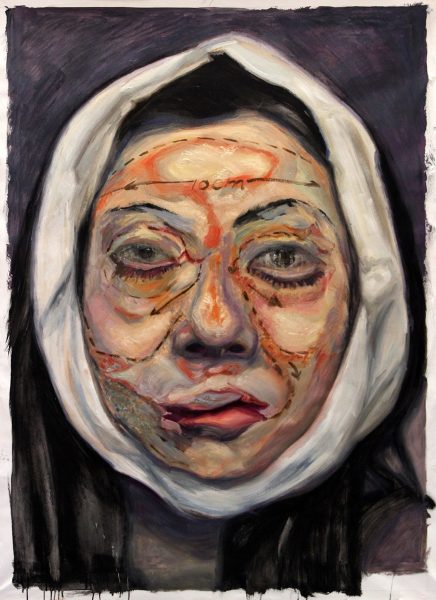
Cover art by arist Su Yang, from: https://nuvoices.com/2019/05/25/carving-out-chinese-ideals-of-female-beauty-visualizations-by-artist-su-yang/

 all things feminist