Dissecting Hoxha’s Regime Through a Feminist Lens
Albania’s paranoid and cultish dictator, Enver Hoxha, was the creator of a 40 year regime characterised by extreme censorship, civil oppression and social mistrust – nearly 200,000 concrete, communist-era bunkers, stand scattered around Albania, acting as a painful reminder of Hoxha’s all enveloping ruling. They were built in order to protect Albania from an ‘enemy’ which essentially never came, however this crazed style of governing went further than Hoxha’s perceived threat of external opponents, it extended to what the Communist Party of Albania viewed as internal “enemies of the people” (kulak), within Albania’s borders. Thousands were persecuted under the guise of public security.
Hoxha has been an incredibly polarising figure in the country and his legacy continues to divide the population, yet it would be ignorant to overlook the achievements and progress the regime helped prompt.
He helped to establish national autarky, diversification of the economy, improvements in healthcare and education, and significantly raising the literacy rate. The majority of policies he pursued were pretty black and white; some were simply tragic, and others were to be celebrated, however one of the most paradoxical elements of his ruling was the emancipation of women. He stated:
“The Party and the whole country should rise to their feet, burn the backward canons and crush anyone who would dare trample on the sacred law of the Party on the protection of the rights of women and young girls.“,
clearly taking a staunchly feminist stance on the ‘women’s issue’. However, it is important to question and dissect to what extent he translated these words into actions, as well as the underlying historical and social currents which worked with and against this change. How much of this ‘dream’ was realised?
For Albanian women, who had previously been solely relegated to the domestic sphere, as a result of earlier systems and societies, such as the rule of the Ottoman Empire, communism undoubtedly brought about a swift social revolution, on par with progress made across European countries. Prior to 1945, women were subject to, and oftentimes limited to, unpaid labour at home, compulsory childbearing, forced marriages and a lack of education. The rigidly patriarchal society meant they were separated from men in all areas of social conduct, from mosques and churches to public celebrations. Such structures of exclusion were finally broken down under communism, which essentially gave women the scope to enter schools, universities and all workplaces: an undeniably enormous step for female emancipation.
The economic liberation of women became a core government policy, since women’s contribution to the national economy and labour force was deemed very important at a macro-level. This freedom saw a nearly equal amount of participation between men and women within work; 47% of the workforce was female during communism. In terms of political representation, the state implemented quotas, which led to 33% of the Party’s active members in 1988 being women and over 40% of those who were elected to the people’s councils. Hoxha’s campaign of alphabetising Albania’s population, which led to the literacy rate jumping from 20% to 98%, disproportionately helped women’s occupational mobility, increasing their opportunities to enter professional careers, which were historically inaccessible to them.
While it is important to recognise such achievements, it is equally as important to note their limitations, one of the most prominent being how culture constrained such policies. Before Hoxha’s regime took place, King Zog I reigned over Albania – under King Zog, the rights of women were state-protected, under the ‘Gruaja Shqiptare’ from 1928 to 1939; literally translated as ‘the Albanian Woman’/Wife, it was a women’s organisation in Albania seeking to enforce King Zog’s progressive policies. Though the policies, for example equal inheritance rights and the right to education, were extremely progressive at the time, in practice, they only helped the cosmopolitan city elite and upper classes, essentially having almost no effect on the majority of Albanian women.
This unfair distribution of improvement can be further seen in the regional divide between the North and the South, which was something Hoxha was keenly aware of. The South, where Hoxha originates from, was deemed more ‘progressive’ and deliberately funded to become modernised, whereas the North was deliberately starved economically, leaving it to be strongly influenced by older tribal and feudal traditions, mostly upheld by “Kanuni i Lekë Dukagjinit” (a set of ancient traditional Albanian laws). Though in some areas, particularly rural ones, its laws remain influential, the Kanun essentially stripped women of many of their rights; it dictated that families must be patrilineal, meaning wealth was to be inherited through the family’s men, and patrilocal, meaning upon marriage, the wife moves into the household of her husband’s family. Among other rules, it dictated that a father was to give a bullet to his daughter’s husband, to permit him murdering her in case she were to disobey her husband. Since the North followed the Kanun more closely, it can be said that the impact of Hoxha’s policies on women had substantially less bearing in the North than they did in the South.
Mirroring other dictatorships, the natalist policy pursued by Hoxha’s government, which promoted the party’s mission of increasing the population at almost any cost, had several crushing impacts on women. In addition to illegalising abortions, the government also restricted contraception, making it available from drug stores but only with a doctor’s permission. There was also a greater level of priority and respect given to women who had more children; for instance, the reward for having six children was that the woman would be able to retire at the age of 50. This resulted in huge population growth in the late 1980’s standing at 2.3%, which was the highest in Europe. However, it of course also led to women having illegal abortions or inducing them on their own: both the number of illegal abortions and infant mortality rate rose as a result of the policies.
Having many children, particularly under such substandard living conditions, as the government advised, was painful, exhausting and dangerous for women, both mentally and physically. Such an emphasis on producing babies, tied with the promotion of women in work, forced many women to hold two jobs: one in the workplace and one at home. Oftentimes, burdens of childcare were passed onto the eldest children, and most especially onto eldest daughters, who prematurely were forced into a role of looking after their siblings. The restrictions on both contraception and abortion meant women also had less self-autonomy; this issue was exacerbated by traditional Albanian ideologies, which discouraged (and still continue to discourage) men from partaking in the majority of domestic and household chores.
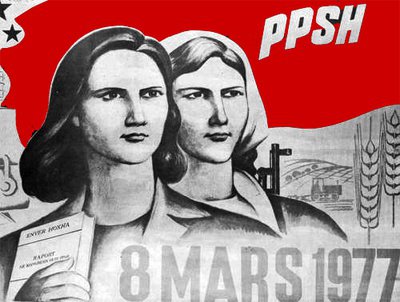
There were some benefits to such policies however, for example, the implementation of extensive maternity leave as well as day-care facilities, which existed even within some workplaces. However, this focus on family policies also led to restrictions and severe social stigmas placed on divorce, which was typically only allowed in cases of adultery. Hoxha’s campaigns of emancipation can be argued to have led to an increase in the labour burdens on Albanian women, without truly bolstering the women’s social value, in the eyes of their male counterparts. His policies of emancipation failed at greatly altering traditional norms, since they limited their scope to women’s role solely outside of the home, rather than both the domestic and public spheres. For most women in Albania, ‘equal rights’ during the Hoxha regime was just another ploy of communist propaganda; mobilised to support the “socialist revolution,” women were forced to join women’s organisations and be faithful to the party, all while keeping their place in the household.
The question of this dictatorship must be evaluated through the perspectives of those that were marginalised: plenty of women benefited under the regime, and yet many were persecuted for defying the strict policies and ideology and cut off entirely from accessing the benefits their female counterparts were given. This era made great leaps in the status of women in one way, however in another, it made women prisoners to both their family patriarchs and the labour force, essentially removing their right to choose, while offering very little social support in return.

The paradoxical nature lies in the interpretation that Albanian women may have felt equal and free whilst at work, however confined and overwhelmed at home. The linkage of gender equality to communist doctrines rather than fundamental re-conceptions of human rights and social roles, on their own terms, limited the range of social progress in communist Albania. The Party failed to directly address women’s role in the family and their status outside of Marxist structures; communist Albania never fully fulfilled its promise of emancipation and this can be seen quite clearly in modern-day Albania. The transition into democracy has opened pathways that allow women to challenge patriarchal norms and attitudes, however, at the same time, it has eroded structures of social protection which were afforded to women under communist rule.
Edi Rama’s current government has been characterised by scandals, mismanagement and corruption, whilst also labelling themselves ‘feminist’; in 2021 he introduced a female-dominated cabinet, as a step to apparently progress women’s social standing. However, Rama has not only used feminism as a tool, but also misogyny – he has famously humiliated and harassed female journalists and colleagues, as well as female activist students – who he has referred to as “whores” and “quacking chicks”. His reforms for higher education are the most neoliberal Albania has ever seen; making his argument that he is pushing for the education of girls completely obsolete. The country now has some of the highest tuition fees for public universities in Europe – specifically affecting the poorest women and girls, particularly those from rural areas.
Access to higher education for women has been such an instrumental tool in helping their social and occupational mobility, even more instrumental for women who are trying to flee a patriarchal, violent family life. Thus, Rama’s “feminist”, “socialist” label has been exposed as a clear ruse: true feminism should involve a welfare state, social protections from a state-sanctioned level and accessibility of higher education for all, especially those who are most marginalised.
Though it has not been realised under Rama’s ruling, it is undeniably vital for Albania to find a way of balancing the economic aggression of capitalist democracy with a strong system of social protection, one which builds upon, not undermines, the small steps made under communism.

 all things feminist